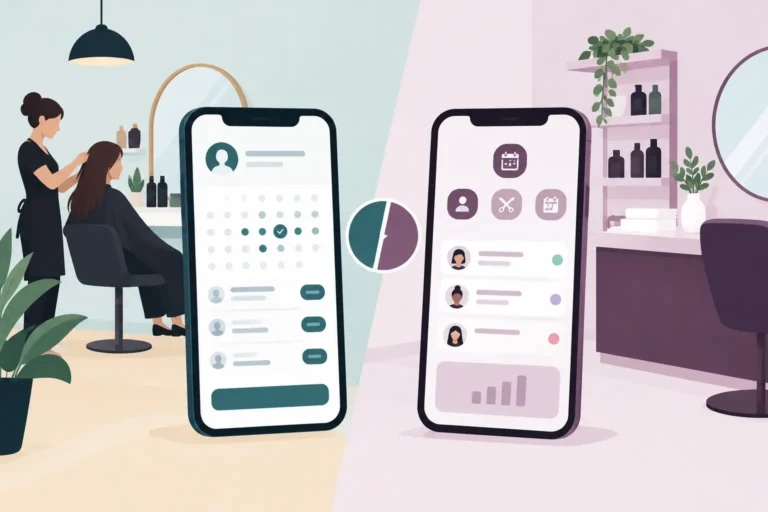
A quiet Tuesday afternoon tells you more about booking software than a feature list ever will. If a client cancels at 10am, can you fill that 2pm gap without sending messages back and forth? And when a regular wants to rebook at 11pm, can they do it without waiting for you to reply?
That is the practical question behind Booksy versus salon diary apps. Booksy can be more than a digital diary, while a salon diary app may give you a simpler way to run appointments, staff time and client communication. The better choice depends on whether you need new-client visibility, day-to-day control, or a balance of both.
What is the real difference?
Booksy is known as a booking platform where clients can search for local beauty and barber services as well as book appointments. For a business looking to be found by people outside its existing client base, that marketplace element can be attractive.
A salon diary app is usually centred on your own business. It gives clients a way to book with you online, while helping you organise appointments, staff rotas, client notes, confirmations and reminders. It is less about competing for attention in a marketplace and more about making your own booking journey easier to manage.
The distinction matters because these approaches solve different problems. A newer barber or nail technician may value the chance to reach potential clients. An established salon with a busy repeat-booking base may care more about reducing no-shows, protecting staff schedules and avoiding empty spaces in the diary.
Booksy versus salon diary apps: a practical comparison
| Area | Booksy | Salon diary app | | — | — | — | | Main focus | Booking tools plus client discovery through a marketplace | Managing bookings and client relationships for your own business | | New client reach | May help clients find your business while browsing locally | Usually relies on your own website, social media and existing marketing | | Booking control | Depends on the platform setup and package | Often designed around your services, availability and working rules | | Daily administration | Can combine appointments with marketplace visibility | Usually keeps the focus on diary, staff, clients and communications | | Best fit | Businesses wanting an additional discovery channel | Businesses prioritising direct bookings and operational control |
This is not a case of one model being automatically better. A marketplace can generate interest, but visibility is not the same as profitable, reliable bookings. Equally, a diary app will not create demand on its own, but it can make it much easier to convert the demand you already generate.
When Booksy may be the better fit
Booksy may suit a business that has spare capacity and wants more local exposure. This can be particularly relevant if you are newly self-employed, have moved premises, opened a new chair or treatment room, or are trying to build recognition in a competitive area.
It can also make sense when your services are easy for new clients to choose without a long consultation. A straightforward haircut, barber appointment, manicure or express treatment is often easier for someone to book with a provider they have not visited before.
There are trade-offs to consider. Marketplace bookings can place your business alongside nearby competitors, so your profile, availability, service descriptions and client experience need to do more work. You should also look closely at current pricing, terms and what happens to client communication and repeat bookings. These details can change, so they are worth checking before committing.
If your calendar has plenty of gaps, discovery can be useful. If it is already mostly filled by regulars, the priority may be making every appointment easier to retain and manage.
When a salon diary app makes more sense
A dedicated salon diary app tends to be the stronger option when you already get enquiries from Instagram, Google, word of mouth or walk-ins. In that situation, your problem is often not being discovered. It is dealing with messages, checking availability, moving appointments and chasing confirmations.
Online booking lets clients choose from the slots you have made available, even when you are with another client. That alone can remove a surprising amount of diary admin. The right setup also helps you set sensible rules around service length, staff availability and booking notice, rather than trying to fit every request into an already full day.
For a salon team, the diary needs to reflect reality. Different team members may offer different services, work different hours or need time blocked for breaks, training and stock delivery. A simple shared view of the day reduces double bookings and the familiar problem of one person promising a slot that someone else has already allocated.
Client records matter too. Notes on preferred colour formula, skin sensitivities, patch tests, previous treatments or preferred barber can improve the experience at the next visit. A diary is not just a calendar when it helps your team remember the details that clients notice.
Do not judge software by bookings alone
A system that takes online bookings but does little after the appointment is made can still leave you with the hardest parts of the job. The useful question is what happens when plans change.
Automated confirmations and reminders can reduce the number of clients who simply forget. They also give clients a clear prompt to get in touch early if they need to rearrange. That gives you a better chance of rebooking the slot instead of finding out at the appointment time.
Waitlists are particularly useful for popular times, such as Thursday evenings and Saturdays. When a cancellation appears, interested clients can be contacted instead of you scrolling through old messages and hoping someone is free. It is a practical feature, not a gimmick, because a single recovered appointment can make a difference to the day.
Before choosing any platform, test these situations in a demo or trial:
- A client cancels a colour appointment the day before.
- A staff member is unavailable for part of a shift.
- A regular wants to rebook with the same professional.
- A new client needs a longer service than a standard appointment.
If the system makes these common situations complicated, it will not feel simple when the salon is busy.
Think about ownership of the client journey
For many independent beauty professionals, the key issue is not just where the booking comes from. It is whether the experience feels like their business from first click to follow-up.
A direct booking system lets you guide clients towards your own availability and services. You can share one booking route across your social profiles, website and messages, then let the diary do the routine work. This is often easier to manage than taking some bookings through a platform, some over the phone and others through direct messages.
That does not mean you must avoid marketplaces. Some businesses use them as one source of enquiries while keeping their core operation organised around a central diary. The important thing is to avoid creating separate calendars that staff have to update manually. That is where missed appointments and double bookings begin.
Compare the cost against the problem you need to solve
Price matters, especially for a sole trader or small salon, but the cheapest option is not always the least expensive in practice. Consider the admin time spent replying to booking messages, the revenue lost to no-shows and cancellations, and the pressure on staff when the diary is unclear.
At the same time, do not pay for a large suite of features you will not use. If you are a one-person home salon, a clear online diary, client records, reminders and a waitlist may be more valuable than complicated reporting. A growing salon may need stronger staff scheduling and shared access from day one.
Check what is included at each plan level, whether you can start small and whether the platform fits the way you currently work. A setup that your team actually uses consistently is more useful than a more complex system left half configured.
A sensible route for UK salons and barbers
Choose Booksy if reaching clients through a marketplace is a central part of your growth plan and you are comfortable assessing its current commercial terms. Choose a salon diary app if your priority is direct bookings, a clearer schedule and less manual chasing.
For businesses that want affordable booking and management tools without making the diary harder to run, UpTor offers a free starting point with online bookings, staff schedules, client records, appointment reminders and waitlists. Set up your real working week first, then see whether the system removes work from it.
The best booking software should make a cancellation easier to recover, a repeat booking easier to secure and a busy day easier to see at a glance. Start with the part of your diary causing the most friction, and choose the tool that solves that problem well.