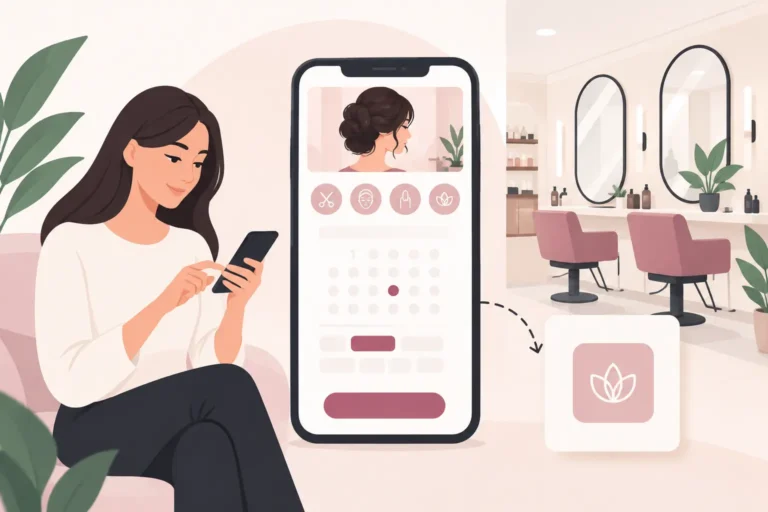
A client searches for your salon at 10pm, finds a booking link and books a colour appointment for Saturday. That is the outcome most businesses want. A white label salon booking app can put your own branding around that experience, but it is not automatically the right route for every salon, barber or beauty professional.
For some established businesses, a branded booking app supports a strong identity and repeat bookings. For others, it adds cost and complexity when a straightforward online booking system would do the job better. The key is understanding what white label actually means, what you are paying for and whether clients will genuinely use it.
What is a white label salon booking app?
White label software is built and maintained by one provider but presented under another business’s brand. In a salon setting, this may mean clients see your logo, colours and business name when they book. Depending on the provider, it could also include a branded web address, client-facing app, appointment notifications or a version of the software tailored to your business.
The attraction is clear. Rather than sending clients to a marketplace or third-party platform, you create a booking journey that feels more like your own. That can be useful if you have invested in your salon brand, built a loyal client base or run multiple locations.
However, the phrase covers a wide range of products. Some providers offer a branded booking page with limited customisation. Others offer a dedicated mobile app published under your salon’s name. These are very different propositions, with very different costs and responsibilities.
White label does not always mean a mobile app
Many salon owners hear “app” and picture something clients will download and use regularly. In reality, persuading clients to install an app for one local business can be difficult unless you have a large, highly loyal customer base or a compelling reason for them to return often.
A mobile-friendly online booking page can be more practical. Clients can open it from Instagram, Google search, your website or a text message without downloading anything. It should still reflect your brand, but it removes a step from the booking process.
Before comparing providers, ask exactly what is white labelled. Is it a booking page, a client portal, a native iPhone and Android app, or all of these? Can your logo and colours be changed? Will the provider’s name appear anywhere? Clear answers prevent an expensive misunderstanding.
When a white label salon booking app makes sense
A white label approach tends to suit salons that already have brand recognition and enough repeat business to justify a dedicated client experience. For example, a multi-chair salon with several team members may want all bookings, staff availability and client communication to look consistent across locations.
It can also make sense for a business that relies heavily on referrals and social media. If clients regularly book through your own channels, keeping them in a branded environment can reinforce the relationship and make the experience feel more professional.
There is a commercial benefit too. When your booking process sits under your own brand, you have more control over how services are presented. You can make it easier for clients to understand timing, choose the right team member and book the correct treatment rather than arriving with the wrong expectation.
That said, branding alone will not reduce diary gaps. The operational basics still matter more: live availability, sensible service durations, clear cancellation terms, reminders and a way to fill appointments that become available at short notice.
The trade-offs to consider before you commit
White label software can give a business more control over presentation, but it can ask more of the business in return. A branded app needs to be promoted, kept up to date and given a clear role in your client journey. If nobody knows it exists, the investment has little value.
The biggest trade-offs usually look like this:
| Area | What you gain | What to check | |—|—|—| | Branding | A booking experience that looks like your business | How much can actually be customised beyond a logo? | | Client ownership | Less reliance on a third-party marketplace identity | Whether you can easily access and use client records appropriately | | Cost | A more tailored experience | Set-up fees, monthly charges and costs for updates or app-store management | | Convenience | One place for clients to return to book | Whether clients will download and keep using a dedicated app | | Operations | Booking can connect with the way your team works | Staff schedules, service timing, reminders, cancellations and waitlists |
Price deserves close attention. A low monthly figure may not include initial configuration, design work, app-store accounts, ongoing updates or support. If a provider is publishing an app under your name, ask who manages updates when Apple or Google changes its requirements.
You should also consider what happens if you change provider later. Can you export your client records, appointment history and service information? Can your branded booking page be redirected? These details matter far more than a polished sales demonstration.
What clients actually need from booking software
Clients rarely choose a salon because its booking system is technically impressive. They want to see available times, select a service, choose a preferred professional where relevant and receive confirmation without having to call during opening hours.
For your team, the requirements are broader. A useful system should show who is working, prevent conflicting appointments, retain client notes and reduce the back-and-forth that comes with rescheduling. Automated reminders and confirmations can help reduce missed appointments, while a waitlist can help you contact interested clients when a cancellation creates a gap.
These functions are often more valuable than a dedicated branded app, particularly for an independent nail technician, barber or small beauty salon. A simple system that clients can use immediately is usually better than a bespoke-looking app that adds friction.
Questions to ask a white label provider
Do not assess a white label product purely from screenshots. Ask to see the full booking flow on a mobile phone and think about a normal busy Friday, not an ideal quiet day.
Useful questions include:
- Is the booking page fully mobile-friendly, and can clients book without creating an account?
- What parts of the experience carry our name and what parts still show the provider’s brand?
- Can we manage staff schedules, service lengths, breaks and different working hours?
- Are confirmations and appointment reminders included, and can we choose when they are sent?
- Is there a waitlist for clients who want cancelled or fully booked slots?
- What support, set-up work, data export and ongoing charges are included?
Also check whether the system fits how you take bookings now. A barber dealing with short, walk-in-style appointments may need a different setup from a salon offering colour corrections, consultations and multi-step treatments. The best choice depends on your service menu, team size and how far ahead clients tend to book.
A practical alternative to building around an app
If your priority is fewer calls, clearer schedules and an easier way for clients to book, start with the booking experience rather than the label attached to it. Put your online booking link where clients already find you, make services easy to understand and ensure your availability is accurate.
For many UK beauty businesses, this is the sensible first step. UpTor gives salons, barbers and independent professionals a straightforward way to accept online bookings, manage staff schedules and client records, send automated appointment reminders and confirmations, and use waitlists to help fill cancelled appointments. It is available with a free plan, which makes it possible to test whether online booking improves the working day before committing to a more customised solution.
A branded app may become worthwhile later, once you know clients are booking regularly online and you have a clear reason for them to return to a dedicated app. Until then, focus on making every booking easy to complete and every cancelled slot easier to refill. Your diary does not need more technology for its own sake – it needs a system that helps your team spend less time chasing appointments and more time looking after clients.