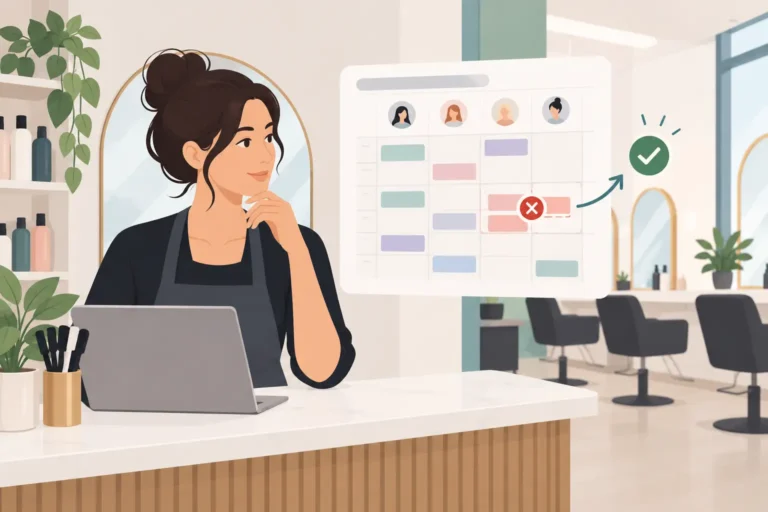
A client arrives for a balayage appointment at 2pm, only to find their stylist is already halfway through a colour correction booked at the same time. It is awkward for the client, stressful for the team and costly for the business. Knowing how to prevent salon double bookings is not just about keeping the diary tidy. It protects your reputation, your staff’s time and the quality of every appointment.
Double bookings can happen in any busy salon, barbershop or beauty business. A receptionist may add an appointment while a client books online. A staff member’s working hours may change without being updated. Or a service may be set up with the wrong duration. The good news is that most clashes are preventable once you put the right rules and systems in place.
Start with one live salon diary
The biggest cause of double bookings is having more than one version of the schedule. Perhaps online bookings sit in one place, walk-ins are written in a paper diary and staff take bookings through Instagram messages or WhatsApp. Each route feels manageable on its own, but together they create gaps in visibility.
Use one calendar as the source of truth for every booking. Anyone who accepts appointments should check and update that same diary, whether they are at the front desk, working from their chair or replying to a client from home. If a client messages asking for a slot, add it to the diary before confirming it, not afterwards.
Online booking software is especially useful here because availability can update as appointments are made. A slot that has just been taken should disappear from online booking immediately, rather than remaining open until someone has time to amend a separate calendar.
Set staff schedules before opening slots
A booking system can only protect the diary if the information in it is accurate. Start with each team member’s normal working pattern, including regular days off, late evenings, breaks and the services they are able to provide.
Then add exceptions as soon as you know about them. Annual leave, training, sickness, school events and shortened shifts all need to be reflected in the diary. If a barber leaves at 3pm for a course but their availability still runs until 6pm, the system may offer appointments that no one can honour.
This matters for chair-rental and self-employed teams too. Each professional should have their own schedule and bookable services. Avoid using a shared generic calendar unless everyone can genuinely perform every service and has identical availability. Clear ownership makes clashes far less likely.
Build in non-bookable time
Back-to-back bookings may look efficient, but they leave no room for consultations, cleaning, colour mixing, payment, late arrivals or a service that needs extra attention. A diary with no breathing space is more likely to run late, even if it does not technically double-book.
Add buffers where they make commercial sense. You might allow 10 minutes after longer colour work, 5 minutes between barber appointments, or a protected lunch break that cannot be booked online. The right amount depends on your services, staffing and usual client flow. The aim is not to create empty time. It is to make sure the time you sell is realistic.
Make service durations accurate
Incorrect service timing is a quieter form of double booking. A client may not be booked into the exact same minute as another client, but a 45-minute appointment may be given 30 minutes in the diary. The result is the same: a stylist is expected to be in two places at once.
Review the duration of every service you offer. Separate services that take meaningfully different amounts of time, such as a root tint and a full-head colour, or a simple gel manicure and detailed nail art. If the timing depends on hair length, thickness or added extras, use a consultation or booking request process for more complex work rather than letting clients select an unrealistic slot.
It also helps to review your timings with the people doing the work. A service menu created months ago may no longer reflect how your team works, the products you use or the level of detail clients expect.
Use booking rules to control availability
The best way to prevent salon double bookings is to stop unsuitable slots being offered in the first place. Booking rules give you control over when and how clients can book without asking you to manually check every request.
Set a sensible minimum notice period. If you need time to prepare for a colour service or arrange staff cover, do not allow clients to book it ten minutes before the start time. You may also want a maximum advance booking window, particularly if rotas change regularly or you have seasonal opening hours.
Think carefully about how multiple services work. A cut and colour may require one longer block with the same stylist. A beauty appointment involving lashes and brows may need two services combined into one booking flow. If clients can book each element separately, they may accidentally choose times that do not fit together.
For businesses with rooms, treatment beds or specialist equipment, availability must account for the resource as well as the staff member. There is little value in having two therapists free if there is only one suitable treatment room. In that case, limit online availability to what the room capacity can support.
Keep manual bookings disciplined
Even with online booking, clients will still ring, walk in or send messages. Those bookings need the same care as digital ones.
Before confirming an appointment, check the staff member, service duration, room or chair requirement and any existing notes. Do not rely on memory, especially during a busy Saturday. Enter the booking straight into the main diary while you are speaking to the client.
It is worth agreeing a simple team rule: no appointment is confirmed until it is in the system. This avoids the common problem of someone saying, “I told her she could come at four,” but forgetting to record it until later.
If several people manage enquiries, give them the same booking process. Consistency matters more than a complicated set of instructions. A short checklist can prevent expensive mistakes.
Train staff to spot the hidden clashes
Not every conflict looks like two names in the same slot. A junior may be booked to assist with a colour service while also being scheduled for a client of their own. A stylist may be free on paper but unavailable because they are covering the reception desk. A treatment room may be blocked for stock delivery or maintenance.
Hold a quick diary review at the start of each day and again before your busiest periods. Look for unusually tight turnarounds, services that need preparation and appointments involving more than one person. This takes a few minutes and gives the team a chance to resolve issues before clients arrive.
When a clash does occur, treat it as a process problem rather than simply blaming the person who entered the booking. Ask what allowed it to happen. Was the rota out of date? Did the service duration need changing? Was an appointment taken through a channel nobody checked? Fixing the cause is what prevents a repeat.
Choose software that updates availability properly
For a growing salon, spreadsheets, paper diaries and disconnected calendars eventually create too much admin. A salon booking system should show live availability, manage individual staff schedules and prevent clients from selecting time that has already been taken.
Look for a system that lets you set service durations, working hours, breaks and booking rules without needing technical knowledge. Automated booking confirmations and reminders can also reduce confusion around appointment times, while a waitlist can help you fill a cancelled slot without opening the diary to guesswork.
UpTor is designed for salons, barbers and beauty professionals who want online bookings, staff schedules, client records, reminders and waitlists in one straightforward place. For an independent professional or a small team, having one clear diary can remove a large amount of daily back-and-forth. You can start for free and set up the booking rules that match how your business actually operates.
What to do when you discover a double booking
Even well-run businesses can face the occasional mistake. Act quickly and be honest. Check whether one appointment can be moved to another team member, whether a small timing adjustment would work, or whether the affected client has flexibility. Contact the client rather than hoping the issue will resolve itself on the day.
If you need to ask someone to change their appointment, give clear options and acknowledge the inconvenience. A client is more likely to stay understanding when they are contacted early, offered a practical alternative and treated with respect.
Afterwards, update the diary rules or team process that failed. A double booking should be rare, but each one is useful evidence about where the booking journey needs tightening.
A calm, reliable diary gives your team room to do their best work. Put the right availability rules in place now, and your clients will notice the difference in appointments that start on time and feel properly looked after.